Outside counsel's memo to the Controller. Required. It is the rule source for Project 2: the dormancy periods, what counts as owner contact, where a balance reports, and who gets a letter. Schedule A is a scanned copy of the signed original, so you have to read it off the page. Read all of it, including the footnotes, and check your rule table against it rather than against an AI.
Download the memo (.txt)Download everything for your AI (.txt)
Fictional memo for a fictional company. Not legal guidance.
Privileged and confidential. Attorney work product.
Frank Whitty Farmer LLP Unclaimed Property and State Tax Controversy
To: Controller, Silicone Motors, Inc. From: F.W. Farmer Date: July 8, 2026 Re: Fall 2026 unclaimed property reporting. Driver wallet balances and vehicle reservation deposits.
1. Why you are receiving this
You asked us to summarize, in one place, the rules that govern the company's unclaimed property reporting for the cycle that closes this fall, so that your analytics team can apply them to the wallet and reservation records without having to read fifty statutes. This memorandum is that summary. It is written for accountants rather than lawyers, and it is intended to be the only authority your team uses for this cycle.
Two cautions before the substance. First, the schedules below are our summary of the law as it applies to the company's specific property types, after the exemptions and elections we have made on the company's behalf over the past three cycles. They will not match a general web summary of any state's statute, and they are not meant to. Where a generic source disagrees with this memorandum, this memorandum governs. Second, the analysis should be done on the population as a whole rather than on a sample, because the report is a filing, and a filing that omits reportable property is the company's liability, not the state's.
2. The property
The company holds two kinds of property that belong to other people.
Stored value in the driver wallet. A driver loads money into the wallet and draws it down by charging at company stations. The balance cannot be withdrawn or transferred. For unclaimed property purposes, the cash the owner loaded is the owner's property until it is spent. Promotional credit the company added is not the owner's property and is never reportable. Your ledger records the two separately by transaction type, and the two general ledger accounts should each be reconciled separately, with any difference between the date a transaction happened and the date it posted explained.
Closing a wallet ends the account in the app. Wallet cash cannot be withdrawn, so some drivers close with a few dollars left, and that balance is still theirs. A closed wallet with a cash balance follows the same rules as an open one. Closing the wallet is not owner contact.
Vehicle reservation deposits. A refundable deposit holds a place in line for a vehicle. Until it is applied to a purchase or refunded, it is the owner's property and it is reportable when dormant.
3. When property is presumed abandoned
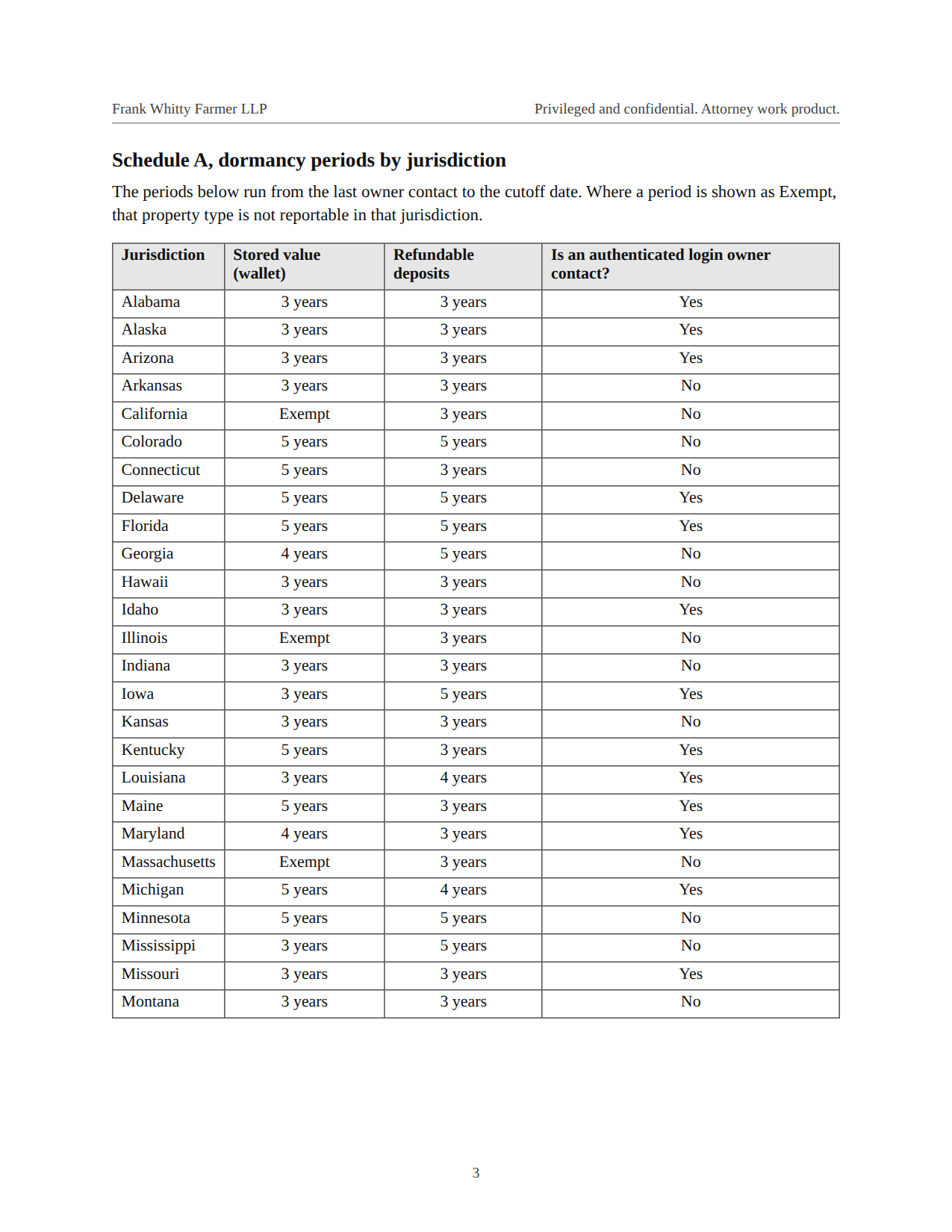
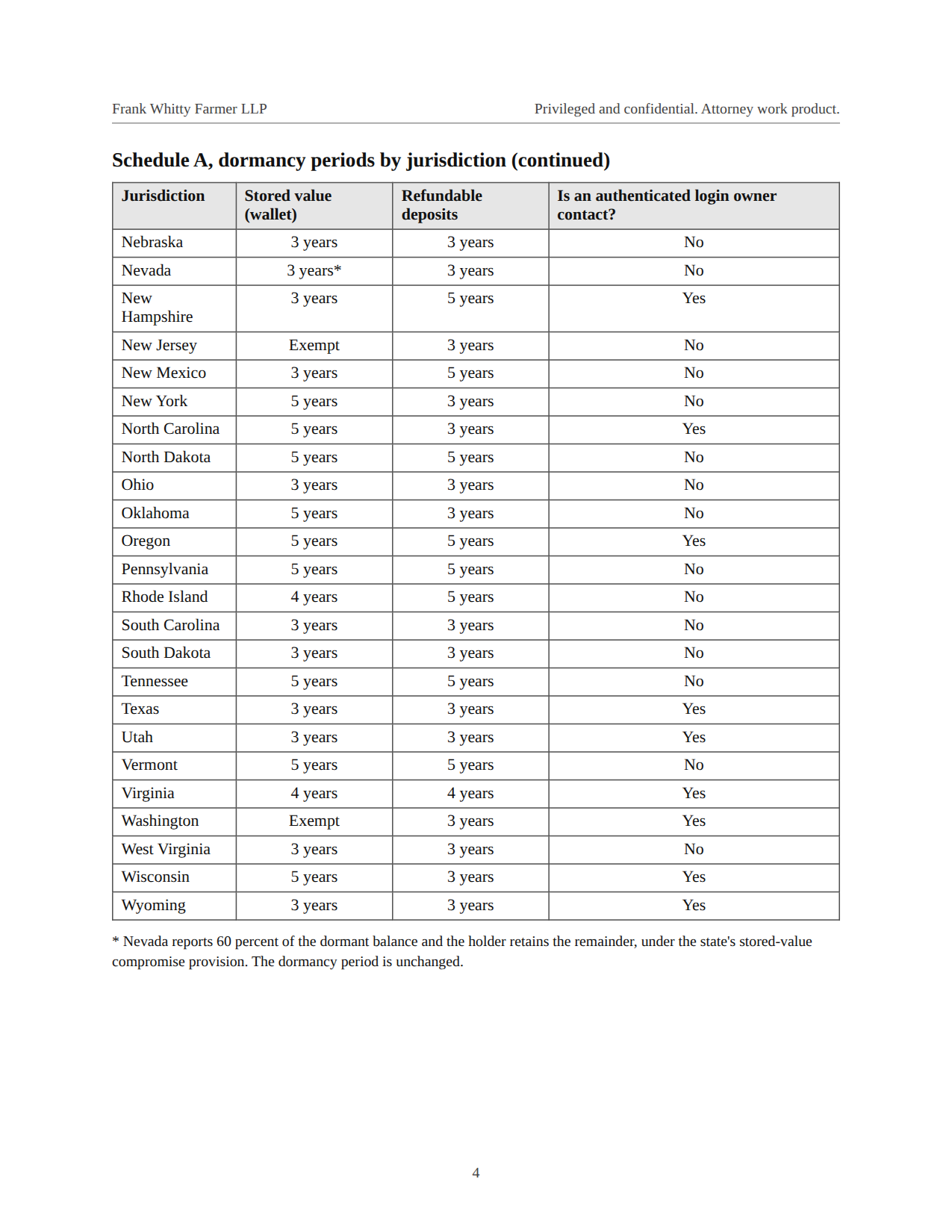
Property is presumed abandoned when the owner has not shown interest in it for the period in Schedule A, measured from the last owner contact to the cutoff date for the cycle. The cutoff for this cycle is June 30, 2026, which requires all date calculations to be as of this effective date.
An anniversary that falls on the cutoff date itself counts as reached.
Schedule A lists all fifty states. The company has drivers in nine of them today, and the full list keeps the schedule usable as the network grows.
Schedule A, dormancy periods by jurisdiction
Schedule A is reproduced on the next two pages from the signed original.
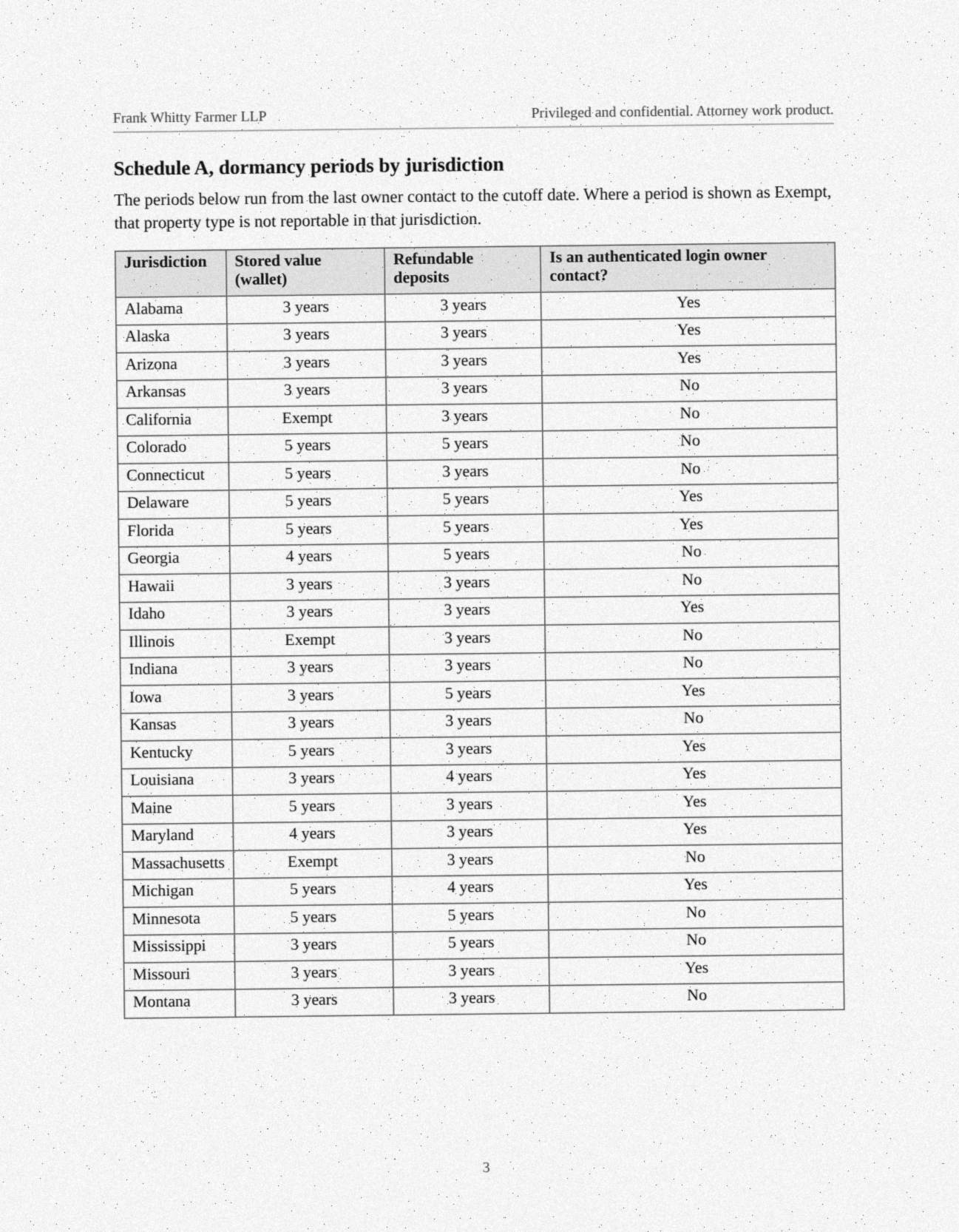
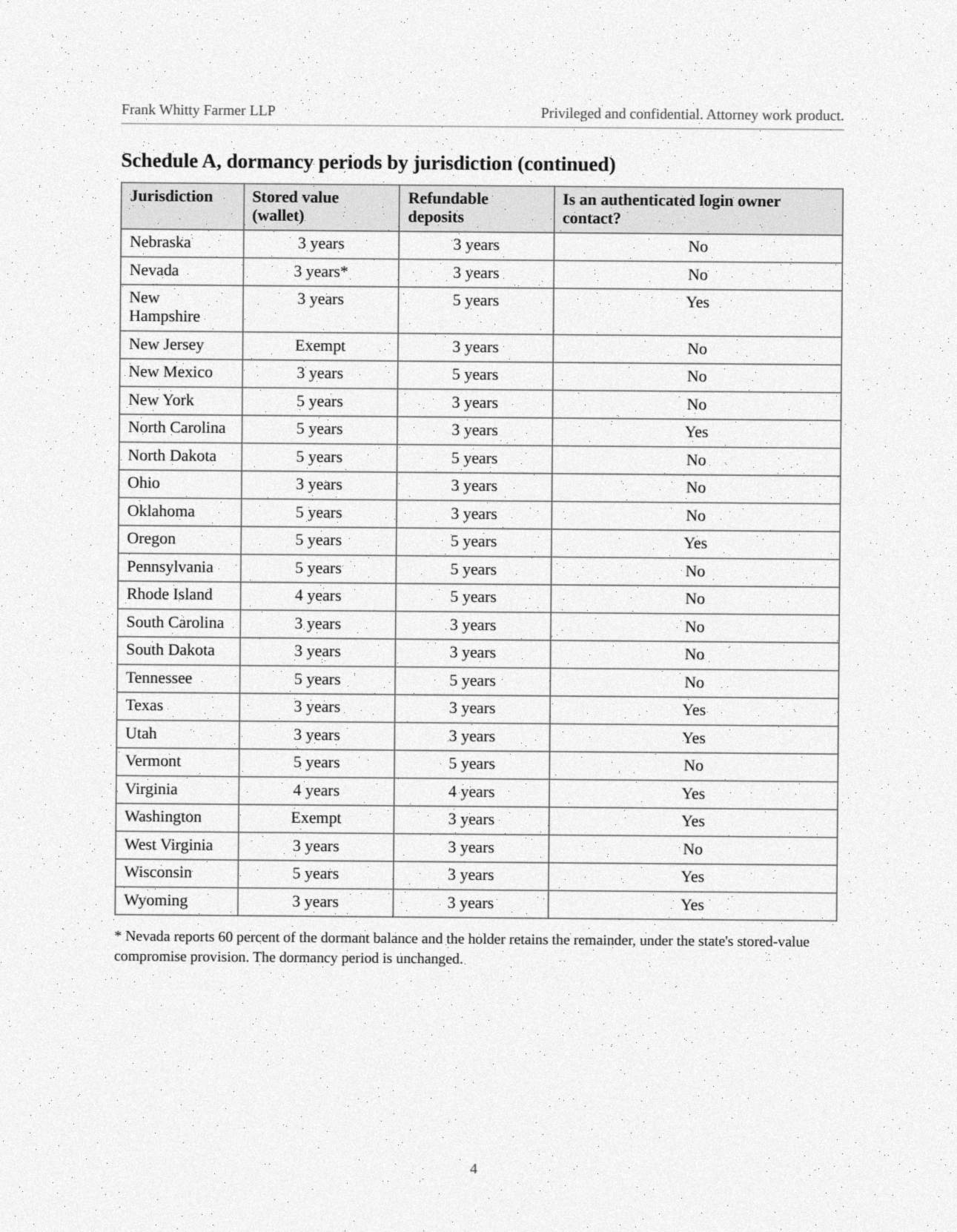
Course note: clean copies of the same two pages are linked here, page 3 and page 4. For an accessible copy of Schedule A, message your instructor on Canvas.
Schedule B, what counts as owner contact
Owner contact means a transaction the owner initiated. In the wallet records that is a row whose channel is one of mobile_app, web_portal, kiosk, ivr, csr_console and whose type is one of load, charge, refund, promo_redeem.
Each item of property runs its own clock. For a wallet balance, owner contact means a qualifying wallet transaction, an authenticated login in the jurisdictions whose Schedule A says logins count, or a documented response to a due diligence letter. For a reservation deposit, it means an owner-initiated event on that reservation. Activity on one item is not contact for the other. A login is contact for the wallet only, never for a deposit.
A charging session is contact through the charge it bills. A session that was never billed is not.
These never count as owner contact, whatever channel they come through: fee, adjustment, reversal, promo_grant, promo_expire. Nothing from batch_job or partner_api counts either. A standing automatic top-up is an instruction the owner gave once. It is not evidence of present interest in the property.
A transaction that has been reversed is not evidence of contact. Nothing happened. A charge that was later corrected by a partial or full refund into the wallet is different: the charge happened, and the owner's dispute is itself contact.
Schedule C, reporting and due diligence
- Property is reported to the jurisdiction of the owner's last known address.
- Where no address was captured, or the address is outside the United States, the property is reported to the holder's state of incorporation, Delaware, under every rule in that state's Schedule A row, its periods and its treatment of logins alike.
- Returned mail does not make an address unknown. The jurisdiction is still the one on file. What fails is the mailing, so no letter is sent. Returned mail is not owner contact.
- A letter is sent to every owner with $50 or more of reportable property, wallet and deposits together, and a mailable address, between July 4, 2026 and September 2, 2026. Mailable means a United States street address on file that has not returned mail, and "returned mail" is the driver record's returned-mail date. The company does not mail due diligence letters abroad, and an owner with no address on file cannot be written to.
- Promotional credit is not the owner's property and is never reportable. Leave promotional credit out of the balance you test and report.
- The report covering property dormant as of June 30, 2026 is due November 1, 2026.
4. Three common mistakes
Returned mail does not make an address unknown. If the postal service returns a statement, the owner's last known address is still the one on file, and the property still reports to that jurisdiction. What returned mail changes is the due diligence step, because a letter cannot be sent to an address that does not deliver. Do not route returned-mail accounts to Delaware. Returned mail is not owner contact.
A standing instruction is not present interest. A standing top-up is an instruction the driver gave the app once, for example to add $50 whenever the balance runs low. A partner integration then makes that load each time, without the driver opening the app. The load is the owner's past instruction at work. It is not evidence that the owner remembers the account today, so it is not owner contact. The same is true of anything the company generates on its own: statements, promotional email, credit expiries, fees, and adjustments.
A transaction that was reversed did not happen. A card load is credited to the wallet when the card is authorized. If the payment then fails to settle, the system reverses the load, usually within a few days. A load that never settled is not contact. Your ledger links each reversal to the row it backs out. Use that link.
5. What we need from you
Course note: the dates in this section are part of the story. You turn in the letter list with the rest of Project 2 on November 1.
We need two deliveries from you.
- By August 15, 2026, this cycle's due diligence letter list: the owners who get a letter, and how many. The letters go out between July 4 and September 2. This list is new for this cycle. Letters from earlier cycles are already in your records, and an owner's reply to one of them counts as owner contact for the wallet, as Schedule B says. Replies to this cycle's letters will come in after the cutoff, so prepare everything as of June 30, before any of this cycle's letters go out.
- By October 25, 2026, a schedule of property presumed abandoned as of the cutoff, by jurisdiction and property type.
We file the report with the states on November 1, 2026, prepared from your schedule.
Please call with questions. We would rather answer one now than amend a filing in December.
F.W. Farmer